In Egyptian Art What Does the Sphere Mean Over the Head
Religion in aboriginal Egypt was fully integrated into the people's daily lives. The gods were present at ane'due south birth, throughout ane's life, in the transition from earthly life to the eternal, and continued their care for the soul in the afterlife of the Field of Reeds. The spiritual world was ever present in the concrete world and this understanding was symbolized through images in fine art, architecture, in amulets, statuary, and the objects used by nobility and clergy in the performance of their duties.
Some of the most of import symbols were:
- Ankh
- Djed
- Was Scepter
- Numbers
- Scarab
- Tjet
- Cheat & Flail
- Shen
- Udjat Eye
- Sesen
- Ben-Ben
Symbols in a largely illiterate club serve the vital purpose of relaying the most important values of the civilisation to the people generation after generation, and so it was in aboriginal Egypt. The peasant farmer would not have been able to read the literature, poetry, or hymns which told the stories of his gods, kings, and history simply could expect at an obelisk or a relief on a temple wall and read them there through the symbols used.
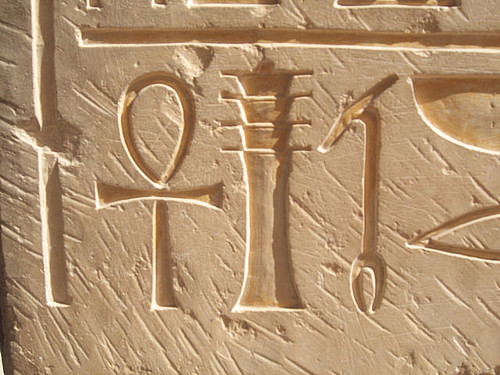
Ankh, Djed & Was
The 3 almost of import symbols, oftentimes appearing in all mode of Egyptian artwork from amulets to architecture, were the ankh, the djed, and the was scepter. These were frequently combined in inscriptions and ofttimes announced on sarcophagi together in a group or separately. In the case of each of these, the class represents the eternal value of the concept: the ankh represented life; the djed stability; the was power. Scholar Richard H. Wilkinson, noting the importance of form-as-part, relates the following:
A fiddling known but fascinating inscription made at the command of the pharaoh Thutmose Four records the discovery by the king of a rock. The significance of this celebrated stone lay not in its being of rare fabric or advent, the inscription tells u.s., but because "his majesty found this rock in the shape of a divine hawk". That an Egyptian king should identify so much importance on a mere rock simply because of its shape is instructive, for it shows how alert the ancient Egyptian was to the shapes of objects and to the symbolic importance which the dimension of form could hold. (16)
The Ankh
The ankh is a cantankerous with a looped meridian which, besides the concept of life, too symbolized eternal life, the morn sunday, the male person and female principles, the heavens and the earth. Its class embodied these concepts in its fundamental-like shape; in carrying the ankh, one was holding the key to the secrets of existence. The union of opposites (male and female person, world and heaven) and the extension of earthly life to eternal, fourth dimension to eternity, were all represented in the form of the looped cantankerous. The symbol was so potent, and so long-lived in Egyptian civilisation (dating from the Early Dynastic Catamenia in Egypt, c. 3150-c. 2613 BCE), that it is no surprise it was appropriated by the Christian faith in the quaternary century CE as a symbol for their god.
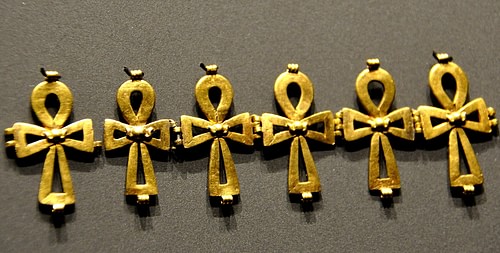
Chain of Ankhs
The origin of the ankh symbol is unknown, just Egyptologist E. A. Wallis Budge claims it may have developed from the tjet, the 'Knot of Isis,' a similar symbol with the artillery at its sides associated with the goddess. Female deities were every bit pop, and seem to exist considered more powerful (as in the example of the goddess Neith), in the early history of Egypt, and perhaps the ankh did develop from the tjet, but this theory is not universally accepted.
The ankh was closely associated with the cult of Isis, however, and as her popularity grew, so did that of the symbol. Many different gods are depicted property the ankh and it appears, along with the djed symbol, in nigh every kind of Egyptian artwork from sarcophagi to tomb paintings, palace adornments, statuary, and inscriptions. As an amulet, the ankh was almost every bit popular as the scarab and the djed.
The Djed
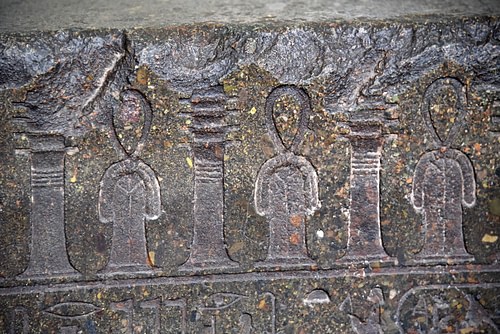
The djed is a column with a wide base of operations narrowing equally it rises to a capital letter and crossed by four parallel lines. It kickoff appears in the Predynastic Period in Egypt (c. 6000-c. 3150 BCE) and remains a staple of Egyptian iconography through the Ptolemaic Period (323-30 BCE), the final to rule the country before the coming of Rome. Although understood as representing stability, the symbol served to remind one of the shut presence of the gods as it as well referenced the god Osiris and so was linked with resurrection and eternal life. The djed was idea to stand for the god's backbone and frequently appears on the bottom of sarcophagi in social club to assist the newly arrived soul stand and walk into the afterlife.
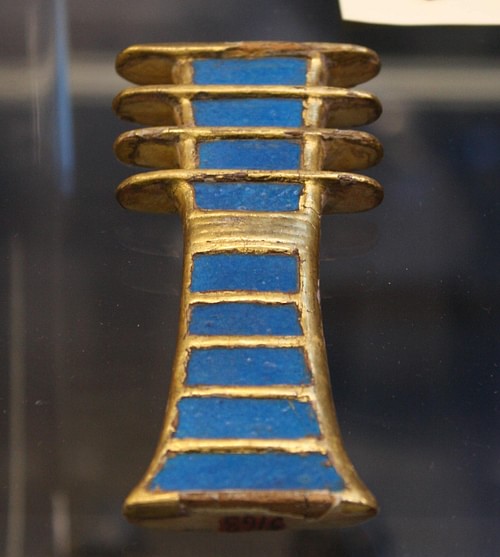
Egyptian Djed
The symbol has likewise been interpreted equally iv columns rising behind each other, the tamarisk tree in which Osiris is enclosed in his most pop myth, and a fertility pole raised during festivals, merely in each case, the message of the course goes back to the stability in life and promise in the afterlife, provided past the gods.
In the interpretation of the symbol equally four columns, the number most frequently appearing in Egyptian iconography is represented: four. The number symbolized completeness and is seen in art, architecture, and funerary goods such every bit the Four Sons of Horus of the canopic jars, the 4 sides of a pyramid, and so on. The other interpretations likewise symbolize concepts associated with the Osiris-Isis myth. The djed as the tamarisk tree speaks of rebirth and resurrection equally, in the myth, the tree holds Osiris until he is freed and brought back to life by Isis. The fertility pole is likewise associated with Osiris who caused the waters of the Nile River to rise, fertilize the land, and menstruum over again to its natural class. In each example, whatever object information technology is claimed to stand for, the djed was a very powerful symbol which was oft coupled with some other: the was scepter.
The Was Scepter
The was scepter is a staff topped with the head of a canine, perchance Anubis, by the time of the New Kingdom (1570-1069 BCE) but earlier a totemic animal like a fox or canis familiaris. The was scepter evolved from the primeval scepters, a symbol of royal power, known equally the hekat, seen in representations of the first male monarch, Narmer (c. 3150 BCE) of the Early Dynastic Menstruation (c. 3150-2613 BCE). By the time of the king Djet (c. 3000-2990 BCE) of the First Dynasty, the was scepter was fully adult and symbolized one's rule and ability.
The scepter was usually forked at the lesser just this inverse co-ordinate to which god or mortal was holding it and and so did the color of the staff. Hathor, associated with the cow, holds the scepter forked at the lesser in the shape of moo-cow horns. Isis holds a like object merely with the traditional fork representing duality. The was scepter of Ra-Horakhty ('Horus in the Horizon'), god of the ascension and setting sun, was bluish to symbolize the sky while that of the sun god Ra was represented with a snake attached to it symbolizing rebirth, equally the sun rose once more each morning.
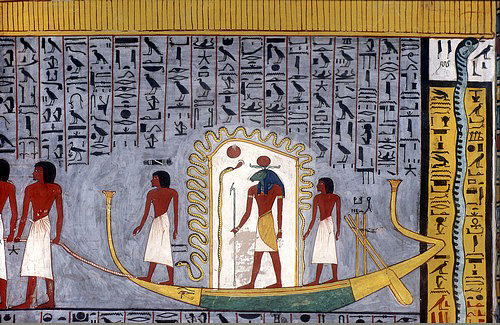
Ra Travelling Through the Underworld
Each god's was scepter denoted their item dominion in ane way or some other. The god Ptah, from the Early Dynastic Period, holds a was scepter which combines all three symbols, the ankh, djed, and was, with a circle at the bottom symbolizing unity. The combination of the symbols, naturally, combined their power which was merely fitting for this god who was associated with creation and known as the 'sculptor of the earth.' The 3 symbols at the top of Ptah's staff, along with the circle at the lesser, presented the overall meaning of completeness, totality, in the number 4.
Significance of Number in Symbols
The combination of the symbols always had a specific meaning. Wilkinson writes, "One of the most important principles for understanding the numerical symbolism of Egyptian representational works is that of the extension of numbers" (138). A two-dimensional work of art, such as an prototype of a god or goddess, is oft depicted in such a fashion that the number four is implied and this practice applies to many numbers so that, every bit Wilkinson notes, "the number actually depicted must exist mentally 'extended' in social club to properly understand its significance in the composition" (138). An example of this is representations of the djed as four columns each rising behind the other. Although the number four represents completeness, the multiplication of four extending toward the horizon would add together the equally important concept of eternity. The djed symbol used throughout the pyramid complex of Djoser at Saqqara is a prime number example of this. At Djoser'due south circuitous, the djed appears on temple lintels actualization to hold up the sky. If the djed is interpreted as four columns multiplied infinitely then the concept of eternity is emphasized through the architecture. The ankh, djed, and was in architecture are frequently employed in such a way equally to double, triple, or quadruple their number for just this kind of emphasis. Wilkinson writes:
A common case of the principle where two represents 4 is found in the pair of was sceptres which were used to depict the pillars of the sky and which were shown standing on the ta or globe hieroglyph, and supporting the pet or sky hieroglyph. This group was frequently used as a framing device around the sides of temple reliefs, symbolically placing the compositions in a cosmic setting. Because these representations are merely 2-dimensional, still, an abbreviated view of the diverse elements is given. (138)
These symbols, singly or together, adorned the items the Egyptians used regularly in their daily lives. Amulets were worn by every class of Egyptian lodge with the djed among the most popular followed by the scarab, the ankh, the tjet, the shen, the was, and others. These other potent symbols were ofttimes paired, or associated, with the three most oft used.
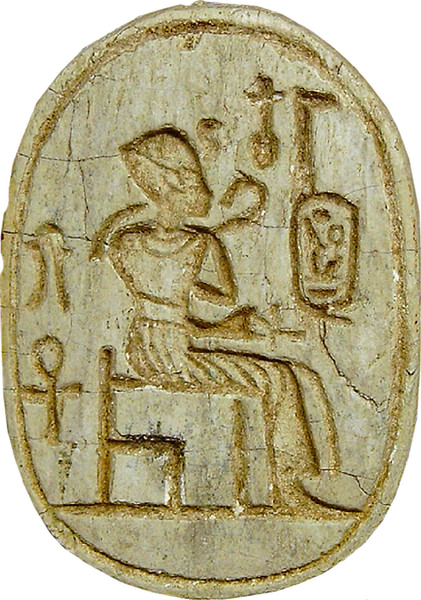
The Scarab
The scarab is the famous beetle image seen in Egyptian art and iconography which represents the Scarabaeus sacer, a species of the dung beetle. The dung protrude was associated with the gods because it rolled dung into a brawl in which it laid its eggs; the dung served as nutrient for the young when they hatched. In this manner, life came from decease.
Scarab
They were closely identified with the god Khepri who was idea to whorl the brawl of the sun across the heaven, go along it safe in its travels through the underworld, and push information technology upward into the dawn the next twenty-four hour period. When Ra became the pre-eminent sun god, Khepri continued in this part as an assistant. Scarabs became pop amulets during the First Intermediate Catamenia (2181-2040 BCE) and remained so for the duration of Egypt's history until the rise of Christianity.
The Tjet
The tjet (tiet, tyet), also known every bit 'the Knot of Isis' and 'the Claret of Isis' resembles an ankh with the arms at its side. The symbol dates to the Old Kingdom of Egypt (c. 2613- c. 2181 BCE) simply is probably older. The tjet has been interpreted as female genitalia, the folds of a woman'southward dress, and the knot of a girdle but, in every case, is associated with the goddess Isis.
Djed & Tyet
Information technology represented protection and security and was oft paired with the ankh, thus offering the dual security of both Isis and Osiris. The tjet was frequently carved on bed posts and the walls of temples and was most pop during the fourth dimension of the New Kingdom of Egypt when the cult of Isis was at its peak.
The Cheat & Flail
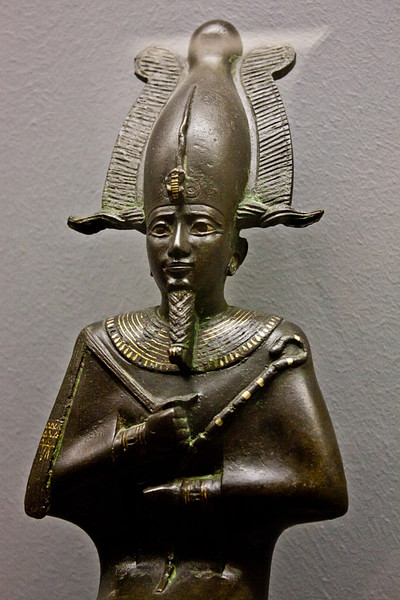
The crook and flail are amongst the most famous symbols from ancient Egypt symbolizing the power and majesty of the king. Both these items were associated with Osiris and symbolized his early dominion of the land. The symbols announced in the Early on Dynastic Flow during the reign of the first king, Narmer (c. 3150 BCE) and linked the king with the mythical first king of Egypt Osiris.
Egyptian God Osiris
The crook was an early on tool used past shepherds while the flail was a means of herding goats and besides harvesting an aromatic shrub known as the labdanum. Since Osiris was originally an agricultural/fertility deity, he was associated with both implements from the Predynastic Period and they served every bit reminders of the past and the importance of tradition as well as, obviously, symbols of the legitimacy and ability of the king.
The Shen
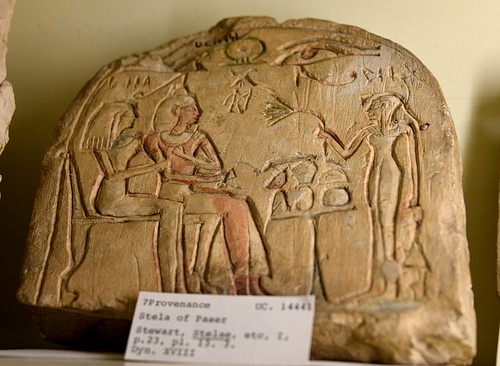
The southwardhen is a circle of rope, knotted, to course an unbroken, circle symbolizing abyss, infinity, and serving every bit protection. The proper noun comes from the Egyptian word for 'encircle.' Shen amulets were frequently worn for protection and shen images appear on a kind of stand, the whole resembling the Greek omega, though this 'stand up' should exist understood as the knotted rope completing the circle.
Stela of Paser
The shen probably developed during the Old Kingdom or First Intermediate Period of Arab republic of egypt but became popular during the Center Kingdom (2040-1782 BCE) and remained and then. The god Horus and the goddesses Nekhbet and Isis are frequently seen holding the shen just other gods are also associated with the symbol. The shen appears on sarcophagi and in temples and tombs besides equally personal inscriptions. The Egyptians greatly valued symmetry and completeness, and so the shen was quite pop and often represented.
The Udjat Middle
The udjat is another well-known symbol from Egypt: the Eye of Ra. The symbol of the eye is associated with the protective goddess Wadjet during the Predynastic Period and continued to be even though information technology was later more regularly linked to Horus, Ra, and others through the motif of the Afar Goddess.
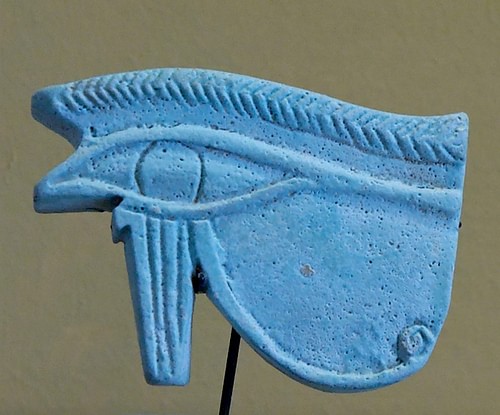
Heart of Horus
The distant goddess story has many forms in Egyptian mythology but 1 consequent plot: a goddess in some way rebels against the king of the gods, leaves her dwelling house and responsibilities behind to journey to a far-off state and must be brought back (or tricked into returning) thus initiating some kind of transformation. The udjat either represented the goddess or was sent to retrieve her and could accept many forms. As the Heart of Ra it was understood to symbolize his watchful presence over creation and is ofttimes depicted in myths (like those of the distant goddess) being sent forth to gather information for Ra. The udjat remained a consistently potent symbol throughout Egypt'due south history.
The Sesen
The sesen is the lotus flower which appears so ofttimes in Egyptian art and symbolizes life, creation, rebirth and, especially, the sun. The symbol dates to the Early on Dynastic Period simply became most pop from the Old Kingdom onwards. The lotus blossom closes at evening and sinks downwardly beneath the h2o, and so at daybreak, it emerges to open over again; this blueprint identified it with the sun and, therefore, with life.
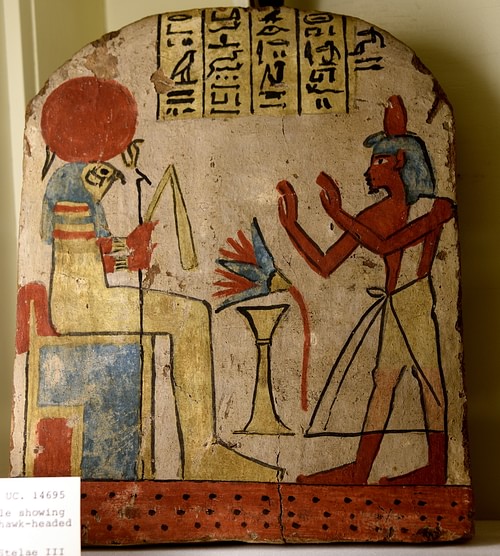
Stela of Ihefy & Horus
The flower also represented rebirth for the same reason and was associated with the god Osiris. The 4 Sons of Horus, regularly represented on canopic jars, are frequently depicted standing together on a lotus in the presence of Osiris. The lotus blossom appears in many different types of Egyptian fine art from faience bronze to sarcophagi, temples, shrines, and on amulets. It was the symbol of Upper Egypt equally the papyrus constitute symbolized Lower Egypt and the flower is sometimes depicted with its stem entwined with that of the papyrus institute.
The Ben-Ben
The ben-ben was the primordial mound upon which the god Atum stood at the start of creation. It is hands the best-known symbol from ancient Arab republic of egypt, later on the ankh, even if one does not recognize the proper name. The pyramids of Egypt, wherever one finds them and from whatever age, stand for the ben-ben as they rising from the globe toward the heavens.
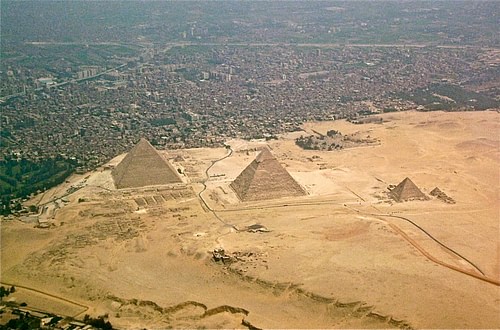
The Pyramids of Giza, Aerial View
Co-ordinate to 1 version of the Egyptian cosmos myth, in the beginning of time, there were only the night waters of chaos in constant motion until the ben-ben rose as the first dry land. Atum (or in some stories Ptah or Ra) stood on the ben-ben to brainstorm the work of creation. The pyramids and other similar structures symbolized both cosmos and eternity by invoking the imagery of this myth.
The ben-ben as a symbol dates from the Early on Dynastic Period just became more than widespread during the Old Kingdom, the time of the peachy pyramid builders when the monuments at Giza were synthetic. It may have been worn as an amulet but more likely was amid the works of art mass produced during the First Intermediate Period as a statuette. The ben-ben appears in many inscriptions from the Old Kingdom through the Late Period (c. 525-323 BCE) and was also engraved on temple walls, tombs, and sarcophagi.
Other Symbols
There were many other important symbols throughout Arab republic of egypt'due south history. The bennu bird, for instance, was the model for the Greek phoenix, and symbolized resurrection. The white ostrich feather symbolized the goddess Ma'at but as well the concept of balance and truth she stood for. The Tree of Life stood for knowledge, purpose, and destiny. Snakes and serpents represented transformation and change. The cobra was a protective prototype, associated early with the goddess Wadjet, who drove off the enemies of Ra; with hood extended and rearing to strike, the cobra became the insignia of kings and was worn on the uraeus, the majestic headdress.
Some other symbol associated with the monarch - and 1 of the most important and ubiquitous - was the winged solar disk known as the Horus Behdety or Horus of Behdet, symbolizing kingship, power, the flight of the soul, and divinity. The symbol is among the oldest in the world and variations of it are seen in many different cultures. In Egypt, it seems to have at offset represented the syncretization of the god of the midday dominicus, Behdety (besides given as Behedeti) and the sky god Horus. In time, information technology came to exist associated with the supreme ability of Horus and his representative on globe, the pharaoh.
Symbols in a largely illiterate gild serve the vital purpose of relaying the most important values of the culture to the people generation after generation & and so it was in ancient Egypt.
The crowns of Egypt in art too take distinct meaning and symbolism. The Red Crown (Deshret) symbolized Lower Egypt, the White Crown (Hedjet), Upper Egypt, and the scarlet and white Double Crown (Pshent), a unified Egypt. Images of the king in battle show him in a blue crown (a Khepresh) invoking the power of the Nile River and the heavens through its color. The god Osiris had his own crown, the Atef, a tall hedjet crown adorned on each side with ostrich feathers and topped by a golden sun disc.
All of these symbols contributed to the rich culture of ancient Egypt and, although they were religious in nature, were never considered 'religious symbols' as a modern mind would interpret the term. In the present 24-hour interval, especially in western countries, religion is considered a separate sphere, singled-out from one'due south role in secular society, just in Egypt, at that place was no such separation. The priests and priestesses of the Egyptian deities, the kings, scribes, and nobility made utilize of these symbols regularly, of grade, but they appear as amulets, inscriptions, and on bronze of every grade of Egyptian society from the greatest king to the most small-scale member of a community.
This article has been reviewed for accuracy, reliability and adherence to academic standards prior to publication.
Source: https://www.worldhistory.org/article/1011/ancient-egyptian-symbols/
0 Response to "In Egyptian Art What Does the Sphere Mean Over the Head"
Post a Comment